 Alison Crawford
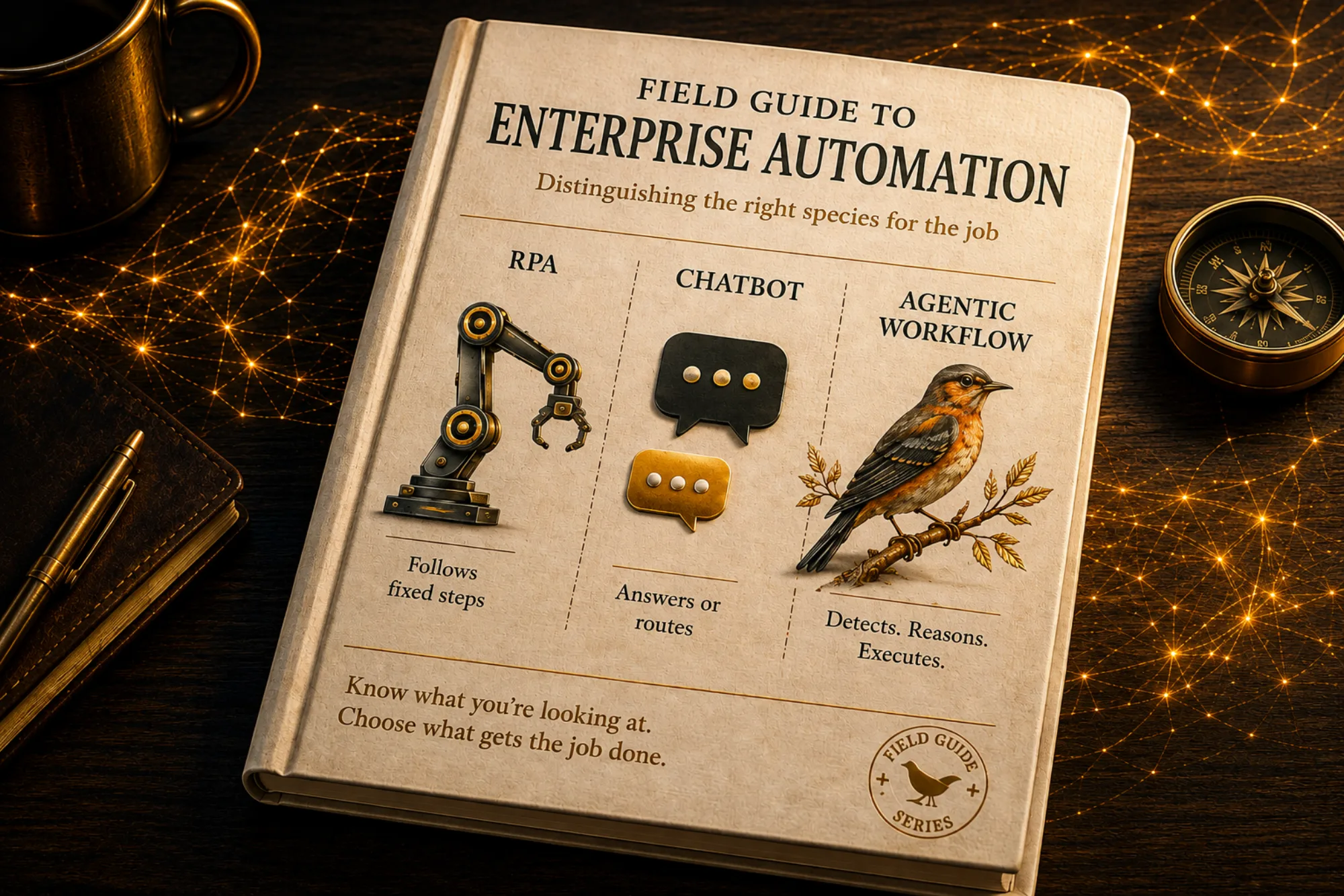
Every vendor in your inbox is agentic now. The RPA company that sold you bots five years ago is agentic. The chatbot company that sold you a support widget is agentic. The consultancy that will build you a custom script is agentic too, apparently. It happened fast, and it happened to the whole category at once, which is usually a sign that a word is being used for its marketing value rather than its meaning.
That would be fine if it only wasted your time reading pitches. It doesn't. RPA, a chatbot, and an actual agentic workflow solve different problems, fail in different ways, and require different things from your team to keep running. Buy the wrong one for the job and you find out during a P1 incident at 2am, not during the demo.
This isn't an argument that Emerix is the only real agentic vendor and everyone else is lying. Some of what's being relabeled agentic genuinely is closer to it than it used to be. The point is narrower: you need a way to tell the difference yourself, in the room, before the contract, because the vendor's slide won't do it for you.
The short version:
- RPA executes fixed steps in a fixed order. It's fast and cheap until the process changes, then it breaks silently.
- A chatbot answers or routes a question. It doesn't reach into your systems and change something.
- An agentic workflow detects an issue, decides what to do about it using the context of your actual business, and executes that decision inside your systems of record.
- The tell isn't the word "AI" anywhere in the pitch. It's whether the system can handle an exception it wasn't explicitly scripted for, and whether it can act on the decision, not just recommend it.
- Human-in-the-loop isn't a sign the system is unfinished. Where the line sits between the agent acting alone and a person confirming first should be a deliberate setting your team controls, not a limitation the vendor is quietly working around.
Why "AI" stopped telling you anything
Three years ago, "AI" in a vendor pitch was a reasonably useful signal. Now it's closer to noise. The word gets attached to a rules engine, a large language model wrapper, and a genuinely autonomous system with about equal frequency, because the commercial upside of saying it is the same regardless of what's actually running underneath.
That's not a complaint about vendors being dishonest so much as an observation about incentives. Buyers ask for AI, so everyone answers that they have it. The useful question was never whether AI is involved. It's what the system actually does when something goes wrong that nobody scripted for. That's the question this guide is built around.
What RPA actually does, and where it breaks
Robotic process automation is real, and it's been genuinely useful for over a decade. It records a sequence of clicks and field entries a person used to do by hand, then replays that sequence on demand. If the invoice always arrives in the same format, in the same field, on the same portal, RPA will process it faster and more consistently than a human ever could.
The failure mode is equally consistent. The moment the input changes, the portal gets redesigned, or a new exception type shows up that the original recording didn't anticipate, the bot doesn't adapt. It either breaks loudly, which at least gets noticed, or it "succeeds" against the wrong data, which doesn't get noticed until the downstream damage shows up somewhere else. RPA has no model of what it's actually trying to accomplish. It has a recording. Ask any team that's maintained a large RPA deployment how much of their time goes to fixing broken bots instead of building new ones, and you'll get an honest answer fast.
What a chatbot actually does, and why it's not the same job
A chatbot, even a very good one built on a large language model, is answering or routing. Ask it a question, and it responds with information or hands you off to the right place. Some are genuinely excellent at this. What they don't do, by design, is reach into a system of record and change something on your behalf. A logistics chatbot can tell a customer their shipment is delayed. It cannot renegotiate the carrier commitment, reissue the purchase order, and update the fulfillment system so the delay doesn't cascade into three other broken promises. That's a different job, with a different set of consequences if it's done wrong, and it requires a different kind of system to do it.
What "agentic" has to mean if it's going to mean anything
If the word is going to carry actual meaning, an agentic workflow needs to do three things RPA and chatbots don't:
- Detect an issue on its own, from the unstructured mess of email, PDFs, and portals your system of record was never built to read, not just from a clean, structured trigger someone predefined.
- Reason about what to do, using the context of your actual business rules and history, so the response fits the situation instead of following a fixed script.
- Execute the decision directly inside the systems you already run, so the outcome is a completed action, not a recommendation sitting in someone's queue.
That third point is where most of what's being relabeled agentic quietly falls short. A system that reasons well but only ever produces a suggestion for a human to act on is still useful. It's a decision-support tool, not a system of action. The distinction matters because the ~40 to 60% of supply chain execution that happens outside the system of record, in email threads and PDFs and manual workarounds, is exactly where recommendations pile up and never get actioned. That gap is what leaks about 2% of revenue for a typical enterprise, roughly $20M a year for a $1B company. A recommendation nobody actions doesn't close that gap. An executed workflow does.
Three questions to ask any vendor claiming to be agentic
You don't need to become an AI architect to evaluate this in a sales cycle. Three questions do most of the work:
- "Walk me through what happens when the input doesn't match what you expected." RPA and thin AI wrappers usually answer this by describing an error state or a handoff to a human queue. An agentic workflow should describe reasoning through the exception, not just catching it.
- "Show me the last step. Does your system update the record, or does it tell someone what to update?" This is the execution question, and it's the one vendors most often answer vaguely.
- "Where does a human come into this, and who decided that?" The honest answer involves a configurable threshold your team controls, tightened or loosened as trust is earned. The evasive answer treats human review as a permanent feature nobody mentions until you ask directly.
None of this is a trick. It's the same due diligence you'd apply to any system you're about to give access to production data and live transactions. The vendors doing agentic work for real will answer these questions specifically, because they've had to build the parts that make the answers true.
Every vendor still in your inbox this quarter is going to call themselves agentic, and most of them will believe it when they say it. That's not a reason to write off the category. It's a reason to stop letting the word do the evaluating for you. The three questions above will tell you more in twenty minutes than another six months of pitches will. Ask them before you sign, not after the 2am incident.
Alison Crawford is Director of Product Marketing at Emerix, the system of action for supply chain execution. She has spent her career in supply chain software, with prior roles at RELEX Solutions, Aera Technology, o9 Solutions, and Kinaxis, and was recognized in the 2023 Women in Supply Chain Awards. She writes about the distance between what supply chain software promises and what it actually executes. Connect with Alison on LinkedIn.
Ready to recover your 2%?
FAQ
Is RPA a type of agentic AI?No. RPA replays a fixed, pre-recorded sequence of steps and has no ability to reason about a situation it wasn't explicitly scripted for. Agentic AI detects an issue, reasons about the right response using business context, and executes that response directly.
Can a chatbot be agentic?Most chatbots answer questions or route requests, but don't take action inside your systems of record. A chatbot can become part of an agentic workflow if it's connected to a system that can actually execute decisions, but the chat interface alone isn't what makes something agentic.
Does agentic AI mean the system acts without any human involvement?No. Human-in-the-loop is a deliberate setting, not a limitation. Where the line sits between the system acting alone and a person confirming first should be something your team configures and adjusts as trust in the system grows.
What's the single best question to ask a vendor to test an agentic AI claim?Ask what happens on the last step: does the system update the record itself, or does it hand someone a recommendation to act on. That answer tells you whether you're buying an executor or a suggestion engine.
Why does the difference between RPA, chatbots, and agentic AI actually matter for supply chain teams?Because the cost of getting it wrong isn't hypothetical. Roughly 40 to 60% of supply chain execution already happens outside the system of record, and unactioned recommendations don't close that gap, they just move where the manual work happens.